
Models, planning, delegation
Problem
Section titled “Problem”The cheapest model per token is not always the cheapest per result, and jumping straight to code with the wrong approach wastes whole sessions.

Actions
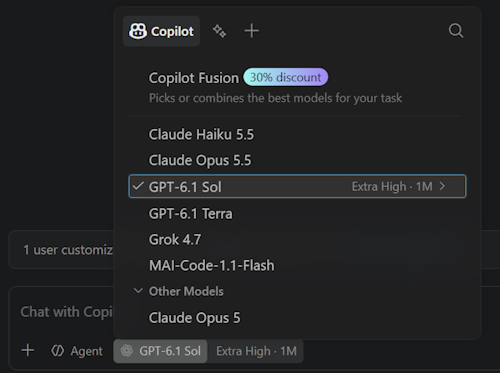
Section titled “Actions”- Choose models on evidence. Define the expected result and how you will judge it; run each candidate more than once (output is nondeterministic); compare completion, quality, reliability, duration, and credits; pick the cheapest model that consistently meets the bar. Re-evaluate as models change.
- Low-maintenance default: use auto model selection. For repeatable workflows, pin a model in a custom agent.
- Leave thinking effort at defaults. Higher effort produces more thinking tokens (cost and latency). Raise it only for genuinely complex work such as architectural planning or multi-step debugging.
- Plan, then implement. Use the Plan agent with a capable model, review the plan, split it into well-scoped tasks, and delegate those to custom agents as subagents with cheaper models, focused instructions, and minimal tools. The primary agent reviews results.
Failure-retry paradox
Section titled “Failure-retry paradox”A simple approximation is total cost = rate × calls × accumulated context (where accumulated context is the average tokens per call). For a synthetic comparison, a model with one-third the token rate that makes four failed test-loop calls and then succeeds uses at least 1/3 × 5 of the frontier model’s one-call cost if their average context is equal; growing tool outputs can increase it further. Real bills also distinguish input, cached input, and output rates. Compare models at the same task success and include retries, tool outputs, and any final successful run.
How to verify
Section titled “How to verify”For a recurring task type, compare (a) one strong model end-to-end against (b) plan with a strong model + workers on a cheaper one. Record credits, retries, and whether the result passes your acceptance check.
Trade-offs
Section titled “Trade-offs”- Delegation itself uses tokens. Keep small tasks in the main session if isolation and a cheaper model do not offset the orchestration overhead.
- A cheaper model that needs retries or creates rework can cost more overall.
Further reading (papers)
Section titled “Further reading (papers)”Ordered by venue tier, then citations. Findings are hypotheses to verify on your own workload; see the full list in Papers.
- FrugalGPT: How to Use Large Language Models While Reducing Cost and Improving Performance — TMLR 2023, 1,247 citations. Selects and cascades LLMs to approach a strong model’s quality at lower cost.
- Hybrid LLM: Cost-Efficient and Quality-Aware Query Routing — ICLR 2024, 519 citations. A router predicts query difficulty and sends easy queries to a smaller model.
- AutoMix: Automatically Mixing Language Models — NeurIPS 2023, 169 citations. Has a small model verify its own answer and escalates to a larger model only when needed.
- Cost-of-Pass: An Economic Framework for Evaluating Language Models — ICLR 2025, 56 citations. Defines the expected cost to obtain a correct answer and compares models on it.
- RouteLLM: Learning to Route LLMs with Preference Data — preprint 2024, 922 citations. Learns from preference data to route queries between a strong and a cheaper model.